Taking another cue from some great stuff Joel is doing, I liked his implementation of the ‘Leopard Screen Saver’ but wanted to make it more ‘real’ for me.  So I wired it up to my Flickr account.  Result here (using Silverlight Streaming):

I only had to change a few things.

First, in the Page_Loaded event, I removed the timer start function.  This was because with interacting with Flickr it was going to be async.  I didn’t want the timer to start until I knew the image collection was built.

My BuildCollection function now looks like this:

private void BuildCollection()
{
    // get Flickr NSID
    WebClient fu = new WebClient();
    fu.DownloadStringCompleted += new DownloadStringCompletedEventHandler(fu_DownloadStringCompleted);
    fu.DownloadStringAsync(new Uri(string.Format(FLICKR_USER_SEARCH, App.FlickrUser)));
}

This is a first call to get the NSID (internal Flickr user_id parameter) based on an initParam the user sends in.  The FLICKR_USER_SEARCH is just a const string parameter to the Flickr API rest call (with my API key in it) which looks like this:

const string FLICKR_USER_SEARCH = "http://api.flickr.com/services/rest/?method=flickr.urls.lookupuser
    &api_key=[yours]
    &url=http://flickr.com/photos/{0}";

I also use a FLICKR_USER_PHOTOS const which is like this:

const string FLICKR_USER_PHOTOS = "http://api.flickr.com/services/rest/?method=flickr.photos.search
    &user_id={0}
    &api_key=[yours]";

The completed event handler for the user search call looks like:

void fu_DownloadStringCompleted(object sender, DownloadStringCompletedEventArgs e)
{
    XDocument resp = XDocument.Parse(e.Result);

    string nsid = resp.Element("rsp").Element("user").Attribute("id").Value;

    WebClient p = new WebClient();
    p.DownloadStringCompleted += new DownloadStringCompletedEventHandler(p_DownloadStringCompleted);
    p.DownloadStringAsync(new Uri(string.Format(FLICKR_USER_PHOTOS, nsid)));
}

to retrieve the NSID.  With that I then start the search photos call to retrieve 42 photos.  The sample is a little hard-coded with count values, but this is just a quick change to see if it would work.  When the async operation to search the photos returns, I use some LINQ to mash them into FlickrImage object types using a custom class I put in my Silverlight application.

public class FlickrImage
{
    public string id { get; set; }
    public string farm { get; set; }
    public string server { get; set; }
    public string secret { get; set; }
    public string title { get; set; }
    public int tagid { get; set; }
    public string url
    {
        get
        {
            return string.Format("http://farm{0}.static.flickr.com/{1}/{2}_{3}_m.jpg",
               farm, server, id, secret);
        }
    }
}

and then the LINQ query:

XDocument xml = XDocument.Parse(e.Result);

var photos = from results in xml.Descendants("photo")
             select new FlickrImage
             {
                 id = results.Attribute("id").Value.ToString(),
                 farm = results.Attribute("farm").Value.ToString(),
                 server = results.Attribute("server").Value.ToString(),
                 secret = results.Attribute("secret").Value.ToString(),
                 title = results.Attribute("title").Value.ToString()
             };

Once I have these, I essentially moved the iteration code Joel had into a foreach loop for my images and then started the timer.

foreach (FlickrImage photo in photos)
{
    Uri imageUri = new Uri(photo.url, UriKind.Absolute);

    if (i <= 16)
    {
        Tile tile = new Tile();
        Media media = new Media(imageUri, true);
        tile.Media = media;

        if (col % 4 == 0)
        {
            row++;
            col = 0;
        }
        tile.SetValue(Grid.ColumnProperty, col.ToString());
        tile.SetValue(Grid.RowProperty, row.ToString());
        this.LayoutRoot.Children.Add(tile);

        col++;
        _tiles.Add(tile);
        _images.Add(media);

    }
    else
        _images.Add(new Media(imageUri, false));

    i++;
}

_timer.Start();

The result is the same visual sample Joel had, but using my live Flickr photos from my gallery.  This is made possible because Flickr has a) a REST api and b) a valid cross-domain policy file.  Both of these enable Silverlight to be a great client for consuming this data.  The visualization could be enhanced to provide mouse-over effects to zoom the picture I suppose, but I’ll get to that later.  Pretty fun that just a few changes (and none to XAML) enabled me to make this real for me.

The code for my changes is here but note you must have your own Flickr API key from their site.  I also implemented supporting an initParams value so you can pass in the Flickr user name dynamically. 

UPDATE: To use the initParams capability and display a badge for your Flickr account, you can use an <iframe> tag and point to http://silverlight.services.live.com/invoke/217/FlickrBadge/iframe.html?u=[yourflickrname] where the [yourflickrname] is the last part of your Flickr photos url.  For example if your account is at http://flickr.com/photos/uhoh_over than you would use http://silverlight.services.live.com/invoke/217/FlickrBadge/iframe.html?u=uhoh_over.


A while back the team at the New York Times newspaper produced a digital reader for their content, dubbed ‘Times Reader.’  The technology powering that reader experience (“the digital newspaper that reads like the real thing”) is Windows Presentation Foundation (WPF), part of the .NET Framework.  It is a remarkable experience for viewing digital news in a traditional format.  It provided online and offline reading capabilities mixed with some new and innovative ways of viewing related stories.

Portions of the reader were even transformed into a starter kit framework: Syndicated Client Experiences Starter Kit.  This kit provides the initial plumbing to produce similar experiences and truly is a great starter kit to use.  Others like the Seattle PI and MSDN have put their content via this mechanism.

This experience of the Times Reader was a Windows-only experience because of the dependency of the .NET Framework.  The Times Reader does provide the best experience because of this dependency however and it is important to note that.  Mac users, unfortunately, were left out.  Until now.

Rob Larson, VP of Digital Production for the NY Times, announced that they’ve been working on a Mac version and a beta will be released soon.  Rob’s team implemented this version using Silverlight.

“We are using Microsoft’s Silverlight technology to render the pages on the Mac version. Silverlight includes a subset of the Windows Presentation Foundation (WPF) tools we use on the PC version. This allows us to keep the look and feel of the Mac version very close to the PC version and also allows us to reuse code across platforms.”  source: http://firstlook.nytimes.com/?p=46

I initially saw a lot of comments in the post about ‘why is this better’ and I think those are from people who haven’t seen the reader experience on the PC.  I have to admit that I’m not a newspaper reader at all, but as a geek, the news I do read is entirely digital…I’ve never owned a physical subscription to anything.  This digital reader experience is unique and fun to play around with (you have to see the search/related stories visualizations) and I think brings some freshness to traditional print news. 

Rob’s post has more screenshots and details about the implementation and future plans, including a comment of their commitment to bring feature parity between the versions.  I’m looking forward to seeing this implemented and hearing from the development team about their use of Silverlight to bring this experience to the Mac platform.

RIApalooza logo

I’m very excited to have the opportunity to attend the RIApalooza event in Chicago in a few weeks (31 MAY).  What is RIApalooza?

RIApalooza promises a platform agnostic and "PowerPoint-Free" zone, which means we are going to forgo the boring marketing pitches in favor of talking technology. RIApalooza is about creating Rich Internet Applications; how to go about building them and what is being built.  source: riapalooza.com

I love the PPT-free zone aspect of it.  I loving having the maximum time to show some real working code, answer questions and see what everyone is working on.  I’ve decided to team up with a great designer, Corrina, where we will demonstrate some fun things.  It should be a great time.  I don’t want to give too much away, so if you are in the area, you should absolutely come.  You can register on the site, so be sure to do so.  I’ll be coming in on Friday and might need to do some fine tune prepping but would love to meet as many folks as possible at the meet-n-greet on Friday night.  Follow me on Twitter if you’d like and hopefully I’ll be able to post where the fun is happening.

I look forward to seeing you there!

In February, the SharePoint team released a Visual Studio extensions kit for SharePoint development.  Just recently they released a user guide complete with samples and walkthroughs.  The sections include:

    • Starting out in SharePoint Development
    • Walkthrough of the VS extensions
    • Team Site project
    • Blank Site project
    • List Definition project
    • Web Part project
    • Workflow projects
    • Project Item Templates
    • Best practices for the VS extensions

They also note that a VS2008 extensions release looks to be targeted for June 2008.  Paul Andrew has all the details with some snapshots on his blog post as well.

[As featured in LifeHacker -- welcome LifeHacker visitors!]

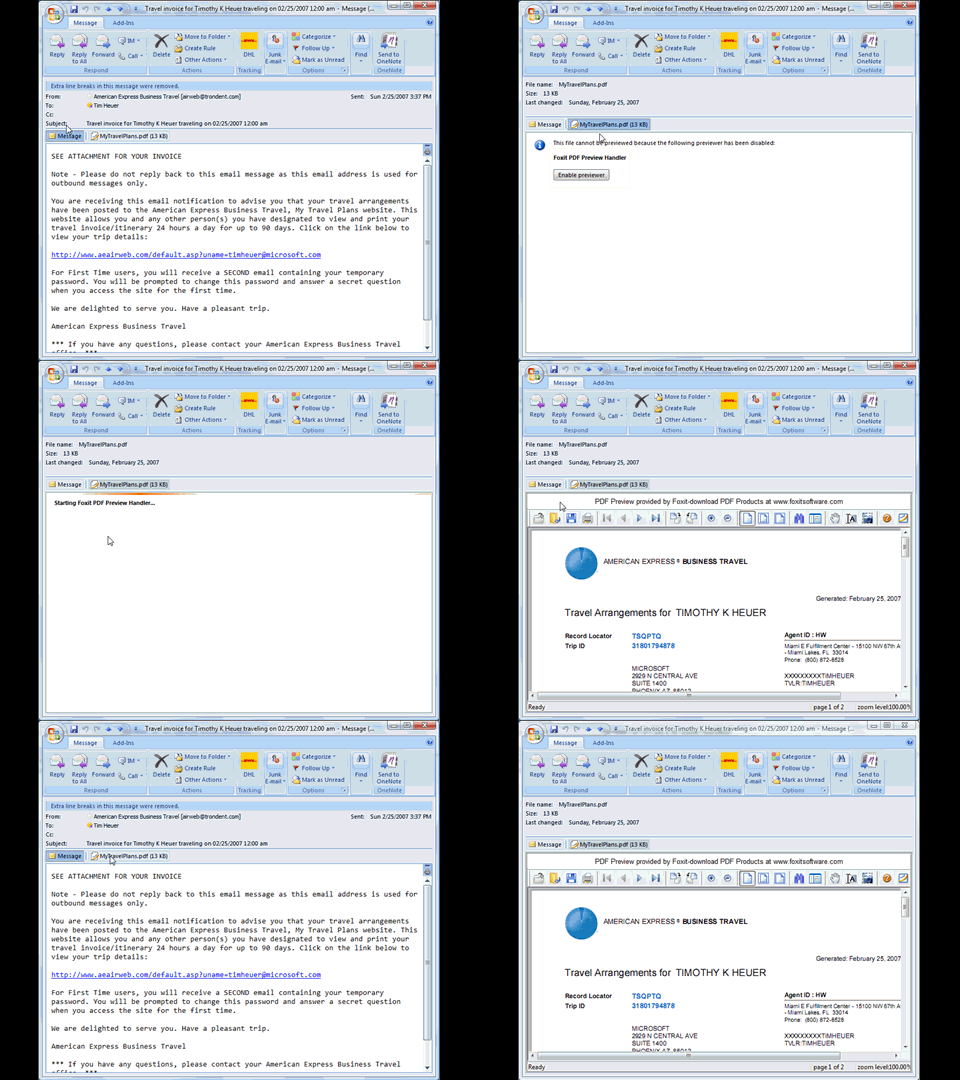
You’ve likely reached this page as a result of a search or a referral.  This page contains the most current links to download the Foxit PDF Preview Handler for Windows Vista, Office 2007 and Windows XP.

The Foxit PDF Preview Handler is a piece of software written by myself with sponsorship from Foxit Software (providing the license so that we all can enjoy).  Special thanks to Ryan Gregg for help with the Windows XP version.  These preview handlers are a part of Microsoft Windows Vista in the operating system as well as in Outlook 2007.

For example, in Outlook 2007, if you receive an attachment that is a PDF you can click it and get a preview of that document right within Outlook without having to open the document in another program.  It is an extremely helpful feature of Outlook that I love and why I wrote this handler for PDFs.  Microsoft did not provide a default one for PDFs as a part of Outlook or Vista.  If you install Adobe Acrobat 8.1+ you will get one as well.  However, I am not a fan of Acrobat Reader as I think it is a slow application for what I use PDFs for – reading only.  For this I prefer Foxit Reader as it is super light-weight and fast.

You can read more about it here.

To download:

This is free software available for you to use.  It is not supported by Foxit Software, but supported by me.  If you find issues, please let me know.