I’ll be joining Dan Wahlin and Rob Bagby on 18 May in Phoenix for a Best of MIX event.  I’ll be presenting Silverlight 3 and building data-driven line-of-business applications.  All demo, all tech, all Visual Studio as my presentation tool :-).

Come out and join us for the event!

Best of MIX Agenda

Monday, May 18, 2009
1:00 PM - 5:00 PM
Wells Fargo Conference Center
100 West Washington Street, MAC S4101-017
Phoenix Arizona 85003

What’s New in Silverlight 3?

Are you interested in building business-focused Rich Internet Applications (RIAs)?  Would you like to take advantage of 3D in the browser, but assume it is too hard?  Have you wanted to take a Silverlight application offline?  Then this session is for you.  We will explore and illustrate the new features of Silverlight 3, including the following:

· Support for perspective 3D

· Offline Support

· .NET RIA Services which simplifies the traditional n-tier application pattern by bringing together the ASP.NET and Silverlight platforms

Building Web Applications with Windows Azure

This session will begin with a brief overview of Azure and discuss some of the announcements made at MIX.  We will then illustrate through demo how to build a Windows Azure application from the ground up.  We will illustrate how to consume Azure Table Storage, how to host services, web pages and Silverlight components, as well as how to deploy your solution to the cloud.

MVC 1.0 vs ASP.Net Webforms

Have you heard about the new ASP.NET MVC  framework from Microsoft and wondered what it was all about? Are you curious whether this replaces ASP.Net Web Forms?  In this session you will learn how to use the model-view-controller (MVC) pattern to take advantage of your favorite .NET Framework language for writing business logic in a way that is de-coupled from the views of the data.  In addition, we will talk about the pros and cons of both MVC and Web Forms, how to determine the best choice for a specific project, various techniques and patterns used to build MVC applications vs. Web Forms applications, and the implications for using each approach.
Register for the Event

We’ve just released an update to our Silverlight Enterprise Deployment guidance/whitepaper.  While a lot of the information from the first version of the guidance (targeted at Silverlight 1.0), we made some minor adjustments outlining the specifics for the updated Silverlight installer and documented some of the command-switches and their behaviors. 

The guidance covers:

  • Using Windows Software Update Services (WSUS)
  • Group policy
  • Microsoft System Center Configuration Manager (SCCM)
  • Manual install options
  • Maintaining and detecting version

It’s a great guidance document to keep in your toolkit if you are in charge of deployment in your organization or want a better way to manage mass deployments of Silverlight across the organization.  You can download the Silverlight Enterprise Deployment whitepaper from the Silverlight community site.

UPDATE: FloatableWindow is now on CodePlex for easier community contributions and management of latest source and builds.  FloatableWindow CodePlex Project.  If you like this idea VOTE FOR IT in the Silverlight Toolkit!

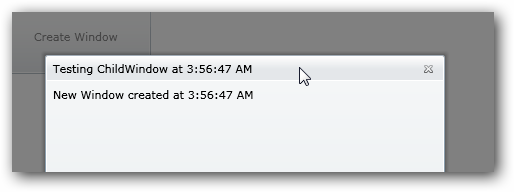
I’ve seen a few comments/requests incoming lately that people like the ChildWindow control in the Silverlight 3 SDK.  This is a great control that creates a modal dialog for you.  When you use it, it disables your root layout application and shows the dialog you provide:

ChildWindow example

This is great for those true modal needs.  It responds to normal windows DialogResult type responses if you have buttons, etc. – great for error dialogs, logins, etc.  The request I’ve been seeing is for the same functionality, but in a ‘normal’ ChildWindow.

But I’ve been seeing requests that it should act more like the normal Window object in .NET, which has an option for showing a window as a ‘dialog’ (modal) versus a normal one.  Well, since the source code is available under Ms-PL license at the Silverlight Toolkit project, I decided to play around and refactor a bit.  If you look at the base class implementation of Window, the API shows two methods: Show and ShowDialog.  This is what I wanted to emulate.  I changed the ChildWindow to FloatableWindow only because I couldn’t think of a better name and it represented a desired behavior.  In ChildWindow, the default behavior is a modal dialog and there are a few key areas that drive this behavior.   There is a template part called Overlay that is responsible for the faded-out background of your app when the ChildWindow is shown.  The other modal semantics are driven by looking at the RootLayout of the parent creating the ChildWindow and changing its properties (IsEnabled=False).  Basically I just spelunked these areas and did some changing.

I implemented a property IsModal (_modal for the private accessor) that would be set in my new show methods, which I refactored to Show, ShowDialog and ShowWindow (internal).  ShowWindow would accept a boolean whether it was to be a modal or not, setting the private accessor.  The calls checking for disabling RootLayout, UpdateOverlaySize, ChangeVisualState and some of the focus event handling (as in a non-modal you may have multiple and you want each to be able to have focus).  After doing this I could create non-modal windows easily:

   1: FloatableWindow fw = new FloatableWindow();
   2: fw.Title = "Testing FloatableWindow";
   3: fw.Height = 200;
   4: fw.Width = 200;
   5: fw.Content = "Created at " + DateTime.Now.ToLongTimeString();
   6:  
   7: fw.Show(); //for non-modal
   8: fw.ShowDialog(); //for modal dialog

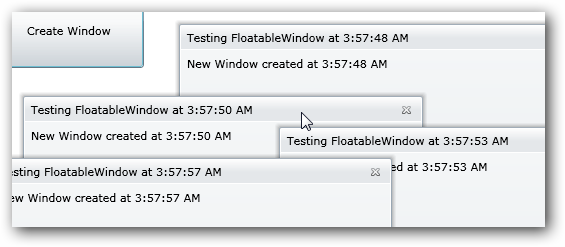
And I could create multiple:

FloatableWindow

All the other functions of the ChildWindow are there so there wasn’t a lot of work to do.  I kept the template parts, etc. so it is customizable in tools like Expression Blend.  There are a few things that I still need to do:

  • Better enable a default start position for the FloatableWindow
  • On focus events, if there are multiple windows, make sure that the selected window gets brought to the front of the layout when being used (NOTE: the logic for this is working actually, but ZIndex doesn’t appear to be able to be set on Popup, which I’m talking with the team about)
  • Whatever other bugs I may have caused by my assumptions :-)

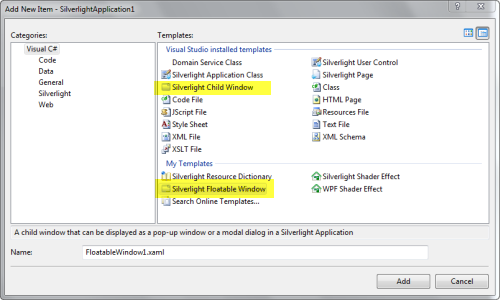
But it was an experiment at least and seems to work so far.  Here’s the code: FloatableWindow_1.1.zip.  The archive file includes the code I used as well as Visual Studio item templates (C# and Visual Basic) to mirror the same functionality of Add New Item where you can add a new ChildWindow to your project as a user control. 

FloatableWindow Item Templates

Let me know what you think.  Hope this helps!

Isn’t RSS great!?  Today I saw something wonderful pop in the feed from Jeff Prosise.  One of the problems with the ‘contest wheel’ app that Arturo and I did, was the CircularPanel we were using really at the time was only built for demo purposes.  There were issues in the spacing when different data items were bound to it.

This morning, Jeff released some code for a RadialPanel (same concept).  It’s wonderful.  I just swapped it out for the contest app quickly and got it working.  I’ve updated the code:

  • Replaced panel with Jeff’s code
  • Added an audio toggle button (after debugging, the music was getting annoying :-))
  • Fixed some highlighting
  • Configured for out-of-browser

Issues if anyone wants to fix :-) -- some highlighting off on selected item because of timer math conflicts as well as just general sizing of the app (configured for full 1024x768 right now without browser toolbars, hence the OOB app).

Anyhow, you can visit the app here (and install offline).  Again, it’s just a fun little app that was written in < 1 hour for fun.

Thanks Jeff for the RadialPanel code!

Public service announcement – if you don’t use my Foxit PDF Previewer, please move along…there is nothing to see here :-).

When Windows 7 Beta came out (build 7000), there was indeed a confirmed issue where the Foxit PDF Previewer would not work at all on 64-bit versions.  There were no install warnings, it just wouldn’t work.  It turns out this was a Windows 7 beta bug for 64-bit (some COM registering stuff if you care to know).  This was found immediately and was fixed in later Windows 7 builds (I confirmed internally with the team and had been testing daily builds).

NOTE: This issue should have only affected 64-bit versions of Windows 7 beta.  32-bit versions were reporting unaffected.

If you will be testing out the Windows 7 Release Candidate for 64-bit, I can assure you that Foxit PDF Previewer will run fine on that build (I’m running it now).  If you choose to install the release candidate on top of the beta, you may run into issues where it thinks it still isn’t working.  I recommend if you are going to go this route, uninstall the PDF Previewer and then run the install again.  This will correct the registering of the software correctly.

I hope this helps!  The download link for the Foxit PDF Preview handler is the same as the Vista one located here.